
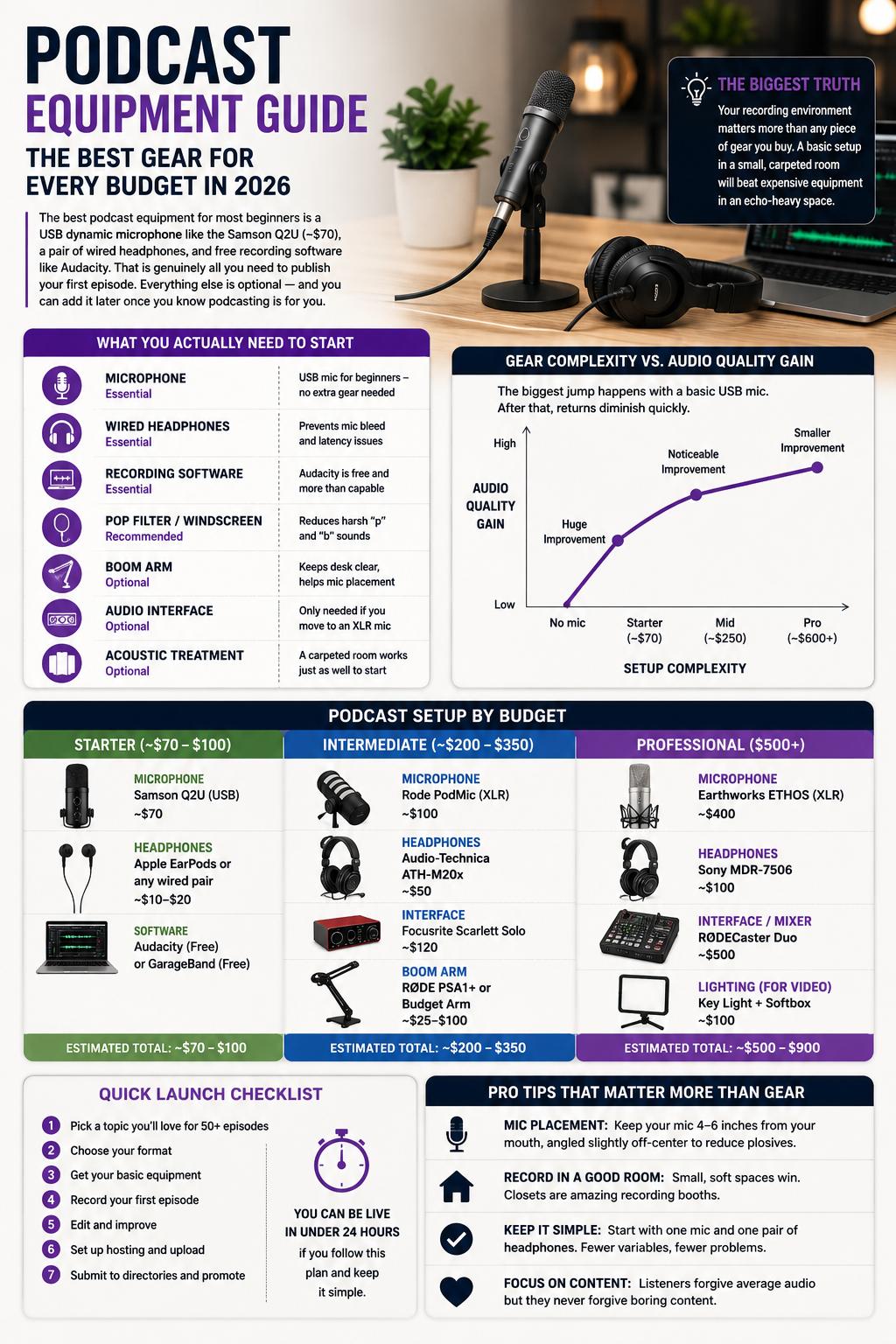
A no-fluff guide covering the real barriers, step-by-step launch plan, growth tactics, and monetisation — written for beginners in 2026.
The Honest Answer (Read This First)
Starting a podcast is not technically hard. It is psychologically hard.
The gear is affordable. The software is mostly free. You can have your first episode live on Spotify in under 24 hours if you really push for it.
What trips most people up is not the microphone or the editing software. It is the self-doubt that kicks in the moment you hit record. It is publishing episode 3 when nobody has left a review yet. It is showing up consistently when growth feels invisible.
Here is a quick breakdown of where the real difficulty actually sits:
| Task | Difficulty | Why |
| Setting up hosting | Easy | Free tools, takes 30 mins |
| Recording your first episode | Easy | Your phone works fine to start |
| Editing audio | Medium | Takes practice but tools help |
| Choosing a topic you will stick with | Medium | Requires honest self-reflection |
| Publishing consistently | Hard | Most podcasts die before episode 10 |
| Growing an audience | Hard | Takes 6–12 months of real effort |
The good news? Every single one of those hard things is a skill you can build. None of them require talent you were born with.
What Makes Podcasting Feel Hard (And What Is Actually Easy in 2026)
Most people overthink the technical side and completely underestimate the mental side. Let us separate the two.
What is genuinely easy in 2026:
Recording and distribution have never been simpler. Free hosting platforms publish your episode to Spotify, Apple Podcasts, and everywhere else automatically. AI-powered tools can clean up your audio, remove filler words, and even transcribe your episode without you touching a thing.
You do not need a studio. You do not need a mixer. A $70 USB microphone and a quiet room will get you 90% of the way to professional-sounding audio.
The three things that are actually hard:
The first is choosing a topic you genuinely will not get bored of. Not something that sounds smart or profitable — something you could talk about for 50 episodes without losing interest.
The second is consistency. According to podcast industry data, the average podcast publishes fewer than 10 episodes before going silent. This is not a gear problem. It is a motivation and systems problem.
The third is audience growth. Growth is slow in the beginning and it can feel demoralising. Most podcasters with successful shows today spent 6 to 12 months talking to a very small audience before things started clicking.
Three myths worth killing right now:
- “You need expensive equipment to sound good” — False. Plenty of top podcasts run on a single $70 mic.
- “You need to be a natural speaker” — False. Pat Flynn sat on his first episode for a year and a half out of fear. He has now published over 850.
- “You need an audience before you start” — False. The podcast IS how you build the audience.
How Long Does It Take to Start a Podcast?
You can technically launch in a single day. Most people realistically take 2 to 4 weeks from idea to first published episode — and that is completely fine.
Here is where the time actually goes:
| Task | Time Required |
| Choosing your topic and name | 1–3 hours |
| Creating podcast artwork | 1 day (DIY) or 3–5 days (outsourced) |
| Recording your first episode | 1–2 hours |
| Editing your first episode | 1–3 hours |
| Setting up hosting account | 30 minutes |
| Getting listed on Spotify | Under 1 hour |
| Getting listed on Apple Podcasts | Up to 24 hours (human review) |
The biggest time sink for most first-timers is not recording. It is overthinking the name, the artwork, and whether the first episode is good enough.
The weekend fast-track path: Pick your topic, name your show, and set up your hosting account on day one. On day two, record and edit your first episode, upload it, and submit to directories. You will be live on Spotify the same day and on Apple Podcasts within 24 hours.
Done is better than perfect, especially for episode one.
How Much Does It Cost to Start a Podcast?
The honest answer is anywhere from $0 to $600 depending on how seriously you want to start. Most beginners land comfortably in the $70 to $150 range.
Here is what each budget tier actually gets you:
| Tier | Cost | What You Get |
| Free | $0 | Phone mic, free hosting, Audacity or GarageBand for editing |
| Starter | $70–$150 | USB mic (Samson Q2U), pop filter, free hosting |
| Professional | $300–$600 | XLR mic, audio interface, closed-back headphones, lighting for video |
Do not overspend before you have published 10 episodes. Your format, your style, and even your topic will likely shift in the first few months. A $600 setup sitting unused because you burned out is far worse than a $70 setup that kept you going.
Audio quality matters — but consistency matters more. Listeners will forgive average audio if the content is genuinely useful or entertaining. The one thing worth spending on early is a decent USB microphone. Built-in laptop mics pick up too much room noise and make editing a headache.
How to Start a Podcast in 2026: Step-by-Step
This is the practical part. Follow these steps in order and you will have a live podcast by the end of it.
Step 1: Pick a Topic You Will Not Get Bored Of
Do not pick a topic because it seems profitable or popular. Pick something you could talk about for 50 episodes without running dry.
A simple test: sit down and write 25 episode ideas right now. If you struggle to get past 10, that topic probably is not the right one. If ideas keep flowing past 25, you are onto something real.
Also think one year ahead. If your podcast was successful 12 months from now, would you still be happy waking up to record it? If the answer is uncertain, keep searching.
Step 2: Choose Your Format
Your format shapes everything — your prep time, your equipment needs, your publishing schedule. Pick one that matches your energy and your life, not what the biggest podcasts do.
| Format | Best For | Difficulty |
| Solo show | Strong opinions, teaching, storytelling | Medium — you carry everything |
| Interview show | Networking, varied perspectives | Medium — scheduling is the hard part |
| Co-hosted show | Natural conversation, accountability | Easy — but coordinating two schedules is tricky |
| Narrative/scripted | Storytelling, true crime, fiction | Hard — high production time |
Start simple. You can always evolve your format after your first 20 episodes.
Step 3: Name It and Brand It
Your podcast name needs to do two things: tell people what it is about and be easy to find. Keep it short, make it searchable, and avoid names too similar to existing shows.
For artwork, the technical spec is a square image at 3000×3000 pixels in JPEG or PNG format. Design it to be readable even at thumbnail size. Tools like Canva work well for DIY artwork, or hire someone on Fiverr for $30 to $80.
Step 4: Get Your Gear and Software
At the starter level, all you need is a USB microphone (Samson Q2U ~$70), any wired headphones you already own, and free recording software — GarageBand on Mac or Audacity on Windows.
Record in the quietest room you have. Soft furnishings absorb echo — a closet full of clothes is genuinely one of the best recording spaces for beginners.
Step 5: Record, Edit, and Export
Write an outline before you hit record. Even a simple bullet list of 5 to 6 talking points will make your episode flow better and cut your editing time in half.
When you record, do not stop every time you make a mistake. Keep going, leave a pause, and cut it in editing. Export your finished file as an MP3.
Step 6: Set Up Hosting and Go Live
A podcast host stores your audio files and creates an RSS feed that syncs your episodes to every major directory automatically. Free options like Spotify for Creators handle hosting and distribution at no cost. Paid options like Buzzsprout start at around $12 per month.
Once your hosting is set up, submit your RSS feed to Spotify and Apple Podcasts. Spotify approves almost instantly. Apple Podcasts takes up to 24 hours.
Step 7: Launch — Soft Open or Grand Opening
A soft open means you publish quietly without announcing it widely. This lets you get comfortable and build a small episode bank before you push for growth.
A grand opening means you build hype first — best if you already have an existing audience somewhere. For most first-time podcasters, the soft open is the smarter move.
The Hardest Part Nobody Talks About: Staying Consistent
This is where most podcasts actually fail — not at launch, but around episode 7.
The excitement of starting something new wears off. Growth is slower than expected. Recording starts to feel like a chore. This pattern is so common in the podcasting world it has a name: podfade.
Batch record before you launch. Record 3 to 4 episodes before your first one goes live. This gives you a buffer so that real life does not kill your publishing schedule.
Set a realistic frequency from the start. A consistent bi-weekly show beats an inconsistent weekly one every time.
Here is how publishing frequency breaks down across real podcasts:
| Publishing Frequency | % of Podcasts |
| Weekly | 38% |
| Bi-weekly | 22% |
| Monthly | 18% |
| Irregular | 22% |
Treat it like a meeting you cannot cancel. Block your recording time in your calendar the same way you would a work commitment. Your first 10 episodes are going to be your worst ones — that is not a problem, that is the process.
Growing Your Podcast: What Is Realistic in Year One
Most podcasts get between 100 and 200 downloads per episode in their first year. That number sounds small but it represents real people choosing to spend time listening to you. Build for that audience first.
Here is a realistic picture of what podcast growth looks like across the first 12 months:
| Timeframe | Realistic Downloads Per Episode | Focus |
| Month 1–2 | 20–50 | Getting comfortable, fixing audio issues |
| Month 3–4 | 50–150 | Finding your voice, building consistency |
| Month 5–8 | 150–300 | SEO starting to kick in, word of mouth |
| Month 9–12 | 300–500+ | Cross-promotion, social clips paying off |
The three growth levers that actually work:
The first is SEO-optimised episode titles. Name episodes after what your listener is searching for, not after a clever phrase. “My chat with John Smith” gets no search traffic. “How to price your freelance services with John Smith” does.
The second is short video clips. Cutting 60-second clips and posting them on TikTok, Instagram Reels, or YouTube Shorts is one of the highest-return activities you can do for growth — as reported by TechCrunch, social media has become one of the dominant channels through which listeners discover new shows, with surveys consistently finding a majority of new listeners citing social platforms as their discovery source.
The third is cross-promotion with similar podcasts. Find shows with a similar audience size, reach out, and offer to swap guest appearances or promo mentions.
Video podcasting in 2026:
Adding a video element to your podcast dramatically changes your discoverability. Spotify now has 170 million users watching video podcasts. A video podcast gives you content for YouTube, short clips for social media, and a deeper listener connection. Your smartphone is enough to start.
Can You Make Money Podcasting?
Yes — but not immediately, and not without an audience first.
Most podcasters do not earn meaningful money until they have a consistent audience of at least 1,000 listeners per episode. That typically takes 6 to 18 months depending on your niche and promotion efforts.
| Monetisation Method | When to Start | Audience Needed | Difficulty |
| Affiliate marketing | Day one | None | Easy |
| Platform ad revenue (Spotify) | When eligible | Varies | Easy once eligible |
| Sponsorships | Month 6–12 | 1,000+ per episode | Medium |
| Paid subscriptions | Month 6+ | Engaged audience | Medium |
| Live events / merchandise | Year 2+ | Loyal community | Hard |
Affiliate marketing is your best starting point. You do not need any minimum audience to start. Pick products you genuinely use and recommend them naturally in your episodes with a trackable link.
Sponsorships come later. A realistic benchmark is 1,000 downloads per episode for smaller brands. According to data from Statista, the U.S. podcast advertising market surpassed $2 billion in annual spend — meaning brands are actively competing for host-read placements, and the standard CPM rates for a 30-second ad sit around $18 per thousand listeners.
Platform revenue programs: Spotify’s Partner Program allows eligible creators to earn from both dynamic ads and Premium video revenue. The key mindset shift: do not start a podcast to make money. Start it to build an audience. The money follows the audience, not the other way around.
Is Starting a Podcast Worth It in 2026?
It is worth it if: You have something genuine to say and the patience to say it consistently for at least a year before expecting results. Podcasting is one of the best ways to build trust with an audience at scale. It is also worth it if you run a business, consult, coach, or have expertise to share.
It is not worth it if: You are starting purely to make money fast, you do not have a topic you are genuinely passionate about, or you are not willing to publish consistently for at least 6 months before evaluating results.
The podcasters who succeed are not the ones with the best gear or the most polished production. They are the ones who showed up every week when nobody was listening.
Conclusion
So — how hard is it to start a podcast?
The technical side is easier than it has ever been. Free tools, free hosting, and AI-powered editing have removed almost every practical barrier that existed even three years ago.
The hard part is everything that comes after you hit publish. Staying consistent when growth is slow. Improving your delivery episode by episode. Building an audience from scratch in a crowded space.
But none of that is impossible. It just requires showing up repeatedly over a longer time horizon than most people expect.
Start with a topic you genuinely care about. Record your first episode this week, even if it is rough. Publish it. Then do it again.
The podcasters who are winning in 2026 are not the ones who waited until everything was perfect. They are the ones who started before they were ready and got better in public.
Frequently Asked Questions
Do I need experience to start a podcast?
No experience is needed at all. Every successful podcaster started with zero episodes to their name. The skill of speaking clearly, structuring episodes, and engaging listeners develops naturally over your first 20 to 30 episodes. The only thing you need to begin is a topic and the willingness to press record.
Can I start a podcast on my phone?
Yes. Your smartphone has a built-in microphone capable of recording a perfectly listenable first episode. Apps like Spotify for Creators let you record, edit, and publish directly from your phone. As your show grows, upgrading to a USB microphone will noticeably improve your audio quality.
How many episodes should I have before launching?
Record at least 3 episodes before you launch. This gives new listeners something to binge immediately after discovering your show, and it gives you a buffer so your publishing schedule does not fall apart the first time life gets busy.
Is it too late to start a podcast in 2026?
It is not too late. There are now over 4 million podcasts in existence, but the vast majority of niches still have room for a show with a clear point of view and consistent publishing. A specific show for a specific audience will always find its listeners, regardless of how crowded the overall market looks.